Monday, January 15, 2007

The thing about India

Sunset over Khuri, in the Thar desert

We leave India for South Africa, via Dubai, with a mixed bag of sadness and relief.

It drives you mad

  • It's a dirty country. The streets are a free-for-all of cars, motorbikes, rickshaws, people, cows, dogs, goats, pigs and tourists - all vying for space, business, food, sex, directions, sometimes simply for survival.
  • It smells of pee. Sanitation (like road rules) is a vague concept - perhaps an unaffordable luxury - not rectified by the occasional "I am clean. Use me" sign on a public convenience. Men urinate where and when they need, everybody shits on the railway lines simply because there's nowhere else to do so and cows have carte blanche. Dogs, presumably, eat so little that they leave little behind.
  • Every man, woman, child, cow and dog on the street wants and expects something from tourists: money, chocolate, pens (kids sell them for chocolate to stall holders, who sell them back to tourists to give to the kids) and food. The standard opening line "Which country, medem (or sir, infuriatingly, when they see only short hair and trousers) is a precursor to a persistent hard-sell of "buy in my shop, very cheap", "Rupee?", "Rickshaw, rickshaw?" Even the holy men ardently flog their blessings at a significant mark-up.
  • Every man, woman and child (and sometimes, one suspects, cow and dog) is either a tout or has a secondary line of business which involves touting. From rickshaw drivers insisting on taking a detour to their brother/uncle's pashmina/crystal/leather shop to children begging for milk that can only be bought from a specific shop at a ridiculous price. (The scam being that the child returns the powdered milk to the shopkeeper in exchange for a commission.)
  • While train travel is a pleasure (at least for us), buying train tickets is not. In the bigger centres, some train stations have special tourist quotas where foreign travellers huddle together in air-conditioned offices to buy tickets in orderly and peaceful conditions. But we feel guilty and, where possible, queue in the "Ladies, foriegners (sic), senior citizens" line. The ladies being young women who buy tickets for their (and others') men folk and the senior citizens very pushy, grumpy old men. The foreigners are polite tourists who wait patiently (but silently seething in the heat), sometimes for hours, while young ladies with immaculate timing and grumpy old men push in with impunity.

Amanda's steed

It touches the heart and makes you want to go back

  • For all the rubbish lining the streets, nothing is ever wasted. What the holy cows and lowly dogs don't consume (rotting vegetables, discarded carton and plastic mostly make their way into some underfed stomach), end up on rubbish heaps where rag pickers meticulously find uses for everything unwanted. The mountain of empty mineral water bottles we tourist leave behind in our budget hotels are a welcome - if labour intensive - earner at one rupee for 100 bottles (8,000 bottles will earn you a pound).
  • It soon becomes apparent that one traveller's beggar or tout is the next foreigner's businessman or entrepreneur who, just like everywhere else, is trying to make a living.
  • The food is excellent. In dark and dingy kitchens, on street corners and in mobile stalls men and women practice culinary magic on little gas hobs and open fires. (Fortunately for the waistline, the wine industry is in its infancy and the result is mostly atrocious - Chateau Indage the closest to being vaguely drinkable.)
  • The Times of India is a very good newspaper (probably better than anything we read in Australia), despite the sometimes idiosyncratic use of English. 49 people dying in a bus accident is not a tragedy but a "mishap". The lonely hearts section is a fascinating insight into caste, arranged marriages, wealth and education. (The first prize goes to a lady looking for "effeminate man or eunuch for marriage". We still wonder whether she found one.)
  • One can have only warm feelings for a country where, in the 1920s, a Maharajah of Varanasi is awarded Belgium's Order of Leopold II for "his prowess in shooting tossed coins with a rifle". Or where our friend Mary visits her very ill husband in a Chandigarh hospital only to discover a monkey having a shower in the en-suite bathroom.
  • And then there's Mr Singh, a Brahmin teacher in Jaiselmer, who, with no outside funding, opened a little cultural museum "to teach the children their heritage". He explains the importance of the kama sutra, without which many women "lay with their head turned away while their husbands satisfy only themselves on top".
  • Luckily for us, we give in to Amerjeet Singh's request to "come to my house, see my children" as he follows us for about 10 minutes through the streets of Chamba. Back home Mrs Singh, an English teacher, grimaces only slightly as her husband brings home yet some more tourists to speak English to her and the children. We spend two hours with them, chatting and admiring photo albums. Amerjeet ever sends the servant to buy us some biscuits.

And there are many more such encounters with extraordinary people, funny people, serious ones, downright weird individuals and people just like us.

We hope India will welcome us back - we still need to get beyond the surface and understand it better.

* We're now in South Africa, not doing a hell of a lot and sad that the great adventure is over. We're booked on a flight on 7 February but may postpone the inevitable until the begging of March.

Ladies walking home with water

Dog in a coat in Delhi


School rickshaw in Paharganj, Delhi

Anger management

Jaiselmer fort

Aids Day in India

Jodhpur, the blue city


Pig in Pushkar

Udaipur City Palace

A lot on her mind

The view on the Lake Palace Hotel from our 'lets spoil ourselves' haveli in Udaipur, and the haveli, Jagat Niwas, below


And the view from the rooftop restaurant

Friday, December 08, 2006

Our first anniversary

Today exactly a year ago we left London for Havana, tired, cross with each other, worried about what we were leaving behind and hardly thinking about what was lying ahead.

Here in Jaiselmer, Rajasthan's golden desert city, over a glass of beer, then a lemon soda and finally a masala chai we perform the necessary toasts to each country we've visited and are yet to visit, with a special double-salute to India and all her touts. We'll be sad to leave in just over a week.

We congratulate ourselves on spending nearly every hour of the past 365 days in each other's company without too much unnecessary scarring. And every now and then the inevitable "can't believe it's already been a year" slips out. Because we can't believe it has already been a year.

We wonder whether we'll ever do another full year, whereupon Amanda's "maybe when we're sixty" makes me reach nervously for an empty beer glass.

We talk of all the places we'd still like to go - from London to Beijing by train, the rest of South and Central America, Laos, Cambodia, Afghanistan etc. We need much more than a year and can't wait until we're sixty.

We finish the evening by buying a skin-and-bone cow six cauliflower heads and 5 tomatoes while turbaned men wrapped in shawls hasten home in the wintry desert night. Near our hotel, a lone camel is parked outside a house, much like a black cab outside a driver's house in Hackney.

It has been a good year for us, and - give or take a few hundred typhoid antigens - we are very grateful to have been so fortunate.

Thursday, November 23, 2006

On typhoid, journalism and the Raj

Patient update
Amanda left hospital after ten days with a cold and more typhoid antigens in her blood than before, as well as an enlarged liver, but feeling significantly fitter and fever-free. Further tests in a few days will hopefully reveal a bug-free outlook. In the meanwhile, the medicine cabinet has nearly doubled the weight of her backpack. (And I should know - I'm carrying both backpacks while the patient regains her strength.)

Since then we've been back on the road, first stopping off in Varanasi on the Ganges. Our hotel overlooked Harischandra Ghat (a burning funeral spot) and so death became part of our daily ritual, along with the best cup of coffee in India and the most superior cheese cake in the world (both at Open Hand coffee and silk shop, owned, of course, by South Africans). We marvelled at the faithful not only bathing but also drinking the near-septic water of the holy river.


Colourful queue into the Taj

And then we hit the All India Cliche Spot - the Taj Mahal in Agra. It is, unequivocally, the most beautiful building in the world - can anyone think of a contender that comes close?

Despite the thousands of tourists jostling for camera space, the ignominy of having to pose for one beautifully dressed family/giggling group of naughty boys/lecherous old men after the other and the potent whiff of a million sweaty feet (shoes have to be removed), we swoon for hours over this mausoleum to love. The sensuous, marble symmetry, the perfect proportion, the sheer romance of its raised position, the jewelled inlay work. It takes your breath away.

We blow the budget - and suffer great guilt - by spending sunset on the balcony of the Oberoi hotel, where I pay Rps 500 (more than GBP5) for a glass of wine while Coups has a lemon soda. To put it in perspective: our hotel room - obviously not the Oberoi - was a 'luxury splashout' at Rps 450.

The train that brought us from Varanasi to Agra (four hours late), is the same train that takes us to Jaipur, capital of Rajasthan, a few days later. We congratulate ourselves on our foresight not to get to Agra Fort station on time for the supposed 6.15am departure, but at 9am. Just as well, because the train eventually pulls in at 10.30.

Jaighar Fort, near Jaipur. Showing the Coups in fine fettle

Jaipur surely wins the award for the Most Hassly Town in the Land. Every rickshaw driver, man, woman, child and goat in the street is a travel industry entrepreneur - whether it be through customised trips (every one has exactly the same customised trip), see my brother/cousin's shop, only look, baksheesh (I thought that was an Arabic word?), I help you/you help me, always accompanied by the Which country? refrain.

It's so draining to apologise for being bad tourists (we're not here to buy, just to walk around the streets and look at the buildings) and nobody accepts no for an answer.


Of course not

Story of the day:
from the Times of India


Negligence cry over death at hospital

ANGRY protests rocked (no less) the premises of a local veterinary (yep, veterinary) hospital on Monday following the death of a cow (what else) allegedly due to medical negligence. An irate mob gheraoed (Indian press loves this word) the 'errant' doctor's chamber for (get this) nearly an hour on Monday - Sunday being a holiday (of course).

...followed by reams of waffle about the unfortunate demise of the poor cow, which, it transpires, received a diarrhoea injection instead of fertility treatment. And then this, surely the most pithy quote from an unlikely source:

Sukdeb Shaw, a milkman of Makrampur, alleged that the vets at the hospital were lazy and never examined their patients. "They read newspapers or chat with pharmacists while clerks turn into doctors."

Hurrah for colonialism
Or at least as far as the dissemination across the former colonies of Marmite is concerned. Thank you, Britain, for enabling me to buy the black gold in a small corner shop, guarded by a sleepy buffalo, in Varanasi and in the madness of Calcutta's New Market. And shame on Australia for daring to think it could do it better with its paltry, repeat-tried-but-failed offerings (Vegemite, Promite, even their own version of Marmite - all shite-mite).

Indian food continues to charm the pants off us (literally) - a cullinary extravaganza that reaches fulfilment every morning with butter toast, covered in our delicious Marmite, and a cup of hot, sweet masala chai. Life is indeed beautiful.

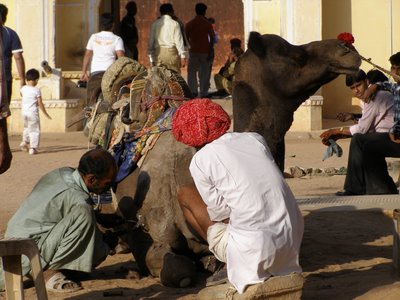
Camel enjoying a shave

Wednesday, November 08, 2006

Typhoid Trixy sweeps across the City of Joys

Trixy directs operations from her command centre at the Woodlands Hospital in Calcutta

I think it's my fault. As I was saying it, I knew I was inviting the gods of fate to a risky dance. On our last night but one, as we were having yet another celebratory meal with people we'd encountered on the Annapurna trail, I boasted with pig-headed confidence that we've been eating our way across three continents without any ill effects.

The next day we had to delay our departure from Nepal by a day because I had erupted at both ends.

Four days later Amanda is running a temperature of 40 degrees Celcius, suffering from severe headache, light sensitivity, no appetite, massive sweats. Within two days she's on a drip in a hospital in Calcutta with severe typhoid.

Yep, despite having forked out the GDP of a small country on vaccinations, lotions and potions - including typhoid - the bird ingested something bad and dirty and succumbed to the inevitable.

It could have been the cold dal baht that we ate against our better judgement on the train to Calcutta or the hidden bits of ice at the bottom of the papaya lassi in the backpackers hangout in Sudder St wot did it, but it could have been anything.

After five days of really being very ill, Amanda is now feeling much better. She's complaining about the ice cream, got the nurses well organised (after an uncomfortable moment of having to explain to one rummaging through her bedside drawer what a tampon is) and is writing down To Do lists for me. (Sympathy cards can be addressed to me)

Hopefully she'll be evicted by the weekend, and be fit to continue travelling. Calcutta is great, but I'm itching to hit Rajasthan. Time is fleeting - despite having delayed our departure from India by 10 days.

Shaky repairs: scaffolding on the Indian Museum


Mum left all her possessions unprotected on the platform for a while


Victoria Memorial at sunset

The Hooghly River with the Howrah Bridge in the background

Saturday, November 04, 2006

Nepal behind us but in our hearts


Supply chain: donkeys with provisions for remote villages in Nepal's Annapurna region

In the dark the rickshaw-wallah stumbles, mumbles and stops. "This India, you get off."

It seems we somehow managed to avoid both the Nepalese and Indian border controls, but no matter, because they're closed in any case, we're told (it's 6.30pm, after all). Come back tomorrow.

So it happens that we spend the night in the veritable shit-hole at the bottom of all shit-holes, a no-hope place where one would prefer to be neither man nor beast. A place where one wouldn't want to be.

Next morning we forego the pleasure of another Nepalese stamp - too far to walk - but decide to keep it legit in India, so pay the customs officer a visit.

His official table is outside the office, which has no roof. He has a moustache worthy of a life-long bureaucrat, is very pleased to meet us, and meticulously enters our details in his heavy ledger. "Your are visitors 923 and 924 this year. Many, many people come to Raxaul." Not by choice, I think. And not that many either.

We chat about cricket, and as we discover later, he represents all Indians in his utter incredulity over India's exit from the ICC Championship. South Africa would be his next choice, but there is Herschel Gibbs and the match-fixing thing, you know.

The serenity of the passport formalities, sitting in the morning sun with only a faint whiff of urine in the air, is complete when we are served a cup of steaming hot chai. Ah, how different could that queue be in Heathrow.

2AC (two-tiered sleeper couch with air conditioning) Mithil Express train (only 20 hours) turns into an unexpected luxury, with clean sheets and a pillow each, as well as two fellow travellers who, apart from the occasional burp, do not fart, spit or rub their genitals excessively.

We arrive in Calcutta at 7am and immediately like the vibe of the city. The moment - and maybe the shock of being back in big, bad, mad, smelly India - proves too great for Amanda and she develops a severe fever of 40 degrees, which we're still struggling to bring under control.

Blood tests for malaria, dengue fever and chikungunya, and checking platelets, ERS and probably the presence of green aliens too, come up alright, but we await the typhoid results with bated breath. And Coups continues to feel grim.

A few random pics:

We saw this amazing 'fairground wheel' in Ghandruk, our last stop on the Annapurna trek, on the last night of the religious festival Tihar (Nepalese version of Diwali, festival of lights)

Celebrating the last day of Tihar with Rajesh, our porter, and Sibrenne from Holland


At the end of Nepal trek there was room on the roof of the bus only - a very refreshing 3-hour ride

One up to the Chinese - their obscene finger juts outs disrespectfully across the square from the Potala in Lhasa

Boogeying down to Madonna in the jeep to Everest Base Camp

Monday, October 16, 2006

Verjaardaggroete van Nepal


Freezing our bits off in front of Annapurna I, the world's 10th highest mountain at 8090m. We walked for days through sun, rain, thunder, hail and a snow storm just to have this photograph taken


Happy birthday, ou tannie. Hoop Ma geniet die dag ten volle.

We wanted to have the picture taken in Tibet with Everest in the background, but I think the altitude affected our memory (and ability to obtain a felt tip). So instead we walked for five days to Annapurna Base Camp to do the necessary at the bottom of the 10th highest mountain peak. (Nepal has 8 of the world's fourteen 8000m-plus mountains.)

Our trek started in beautiful sunshine, with the only eventful moment on the first day being the elastic failure of my cherished black and white stripey underwear (Marks & Spencer, 1997 collection), which to the delight of Amanda, a herd of buffalo and three Tibetan refugee ladies, elegantly peaked out from the bottom of my shorts (only the left leg though; my right hip managed to hold up my dignity). I now only have five pairs of knickers left.

We walked up a very steep mountain and down the other side, just to scale another massive vertical incline and down again. And so on. All the way, every day for eight days. But it is spectacular and we enjoyed every painful, knee-jarring moment. The apple pie, dal bhat (lentil soup, rice, curry and pickle) and Snickers were very helpful in agony management.

The trek was also very good for talking in tongues, and I managed to speak French, German and Dutch about as much as English, while we both realised that our Spanish has been woefully neglected since South America when we met Joseba from San Sebastian. No Afrikaans, but we did meet three South Africans who also live in London.

The higher we walked, the colder it got (and the more expensive the guest houses and food - understandably so, because every morsel has to be carried up the mountain on some skinny but very strong guy's back).

The meteorological culmination was the walk up to Macchapuchre Base Camp in a snow storm (only for about an hour, admittedly), but the cold was quickly banished by sitting in the dining hall of the guest house with a flame thrower under the table for heat. (It's up to the individual to ensure that their feet/legs/rest of body are not incinerated.)

We're back in lovely Pokhara by the lake, eating steak, pizza, ice cream and fresh salads - often all at the same time. On 29 October we will be feeling severely car sick on a bus to the Indian border.


We walked up the million stairs of the Swayambunath Stupa (Monkey Temple) in Kathmandu for this one. It was clearly somewhat warmer than Annapurna Base Camp.

Tuesday, October 03, 2006

Tibet - a very nice part of China

Dear Dalai Lama

It pains me to tell you - although I am sure you already know - that the country you once knew is now irretrievably part of the People's Republic of China. Your people are Chinese - they only look and dress differently, and practice a different religion. A bit like the indigenous people of the Andes and the descendants of the Spanish being Peruvians or Bolivians.

To Lhasa we tourists flock with such great excitement and expectation of an exotic otherness, only to find a thoroughly Chinese city, with a few quaint 'original' quarters.

We glower at the military guards at the Potala, your former palace, and try not to go to Chinese-owned restaurants, shops and hotels, but it's difficult because we don't always believe them when they tell us something belongs to Tibetans. And we know that we can't blame the average person for what's happened. (It'll be like resenting our German friends for the Holocaust, right?)

We are infuriated by the gross disrespect that is the People's Square with its obelisk like an obscene finger in the air - as in all other towns, mockingly facing your important monasteries, and most blatantly so your Potala.

And you were right about the train from Beijing to Lhasa. (The building of the railway line was an engineering feat, and even completed ahead of schedule.) It opened on 1 July this year, and already it has spilled more than 400,000 tourists into the streets of your city. The smartly dressed set demand the luxuries of Beijing and Shanghai, push up the price of everything and, together with the Westerners, shove their cameras in the faces of the 'quaintly dressed' pilgrims from out of town.

Your monasteries - those that survived the Cultural Revolution or, ironically, have been rebuilt by the Chinese - fill us with awe, but we have to confess to virtual monastic overload. One monastery stacked to the rafters with the most priceless Tibetan treasures per day fills the mind too much to contemplate a second.

But even we who didn't know the real Tibet question the authenticity and sincerity of the monks who perform their duties according to Chinese dictates and are surrounded by camera-toting tourists. The debating sessions, shown to the world by Michael Palin, feels like a circus, with the monks beefing up their palm-slapping for the greedy mass of digital cameras.

It brings a mixture of sadness and unpalatable taste in the mouth. How, do we ask ourselves and our shy guide, can real monks practice, learn, teach and evolve their religion in such an unquiet environment? The gentle (Tibetan) guide cannot or will not answer.


Some days we say it's not so bad - maybe because we don't look deep enough, the surface looks content and well-fed. Then, on the gringo grapevine, we hear of foreigners who witnessed the gunning down of 7 Tibetans trying to cross into Nepal, and the bile of helplessness rises again.


We notice, too, the new, bland, flimsily built housing - next to piles of rubble, and we know that your people's pretty, sturdy houses are still being destroyed in the name of egalitarian sameness. (Is this part of what some call cultural genocide?)

But you know all of this, don't you? Is that why you're no longer calling for independence for your country, but asking for it to be treated as an autonomously governed territory? For the freedom to elect your own religious leaders?

They still laugh, though
However, the spirit of your people is not completely broken. The young girls with the rosy cheeks giggle at the grandfatherly flatterings of our fellow overlander Yuda, and the men mock-wrestle him with great guffaws. And, admittedly very seldom, we feel deeply for the elderly man or woman who refuses vehemently to be photographed. There is a quiet pride that will not be crushed that easily.

We are at first repulsed by the people defecating in the open, sometimes on designated corners, other times whenever nature demands, but realise that in this arid, high-altitude country that it is the best path to rapid decomposition.

Speaking of high altitude, can you remember the crisp thinness of the air here? It at once intoxicates with its sweetness and nauseates with its lack of oxygen, until the brain and blood reach acceptance and we become ourselves again.

The Friendship Highway (who do the friends refer to? and how can it be called a highway? It didn't exist when you fled to India in 1959, did it?) from Kathmandu wends its way up gaspingly to Lhasa via Shigatse, Gyantse and the most spectacular views of Mount Everest. We foreigners are only allowed to visit on an 'official' trip, but the authorities are so sure of total surrender that these days we're allowed to stay on as individuals for a further 15 days. We don't get a stamp in our passport, only on our paper permit.

The barren bigness of the countryside takes our breath away, and your people harvest the barley in essentially the old way, although a few tractor-like harvesters are starting to appear. The whole family still work the land together.

I include a few pictures of Tibet - as seen through the eyes of foreigners spending 21 days on the roof of the world.


Our first glimpse of Everest

A ruin in the countryside


Monks


The Friendship Highway


A boy with a new toy


A pilgrim from afar


Prayer flags


The morning sun hits the Potala


Barley harvest


Prayer wheels

Tuesday, September 26, 2006

A quickie

We only had to wait eight hours for our flight to Kathmandu, Amanda blamed me only about nine times for not telling her about the airline's poor record, we had a great in-flight meal, the wing did not fall off and we got to our very nice $8 hotel at 4am. All's good.

Kathmandu is a real gringo breakfast heaven - banana pancakes, muesli, curd and fruit to die for and PROPER coffee. But it is also beautiful, with great local food, very friendly people (if slightly desperate to sell their wares), amazingly interesting little alleyways, impressive Durbar (palace) complex and even more intriguing ones in the outlying villages.

Can't for love nor rupees upload any photographs in the internet cafe, so it will have to wait until we're back in India.

Tomorrow we head to Tibet in a Jeep with a two Spaniards and a couple of Israelis. We're slightly concerned about altitude sickness - we're at 1,300m in Kathmandu, but rise within a couple of days to close to 6,000m. Remain hopeful that our experience in the Andes counts for something.

The trip to Lhasa (Tibetan capital) takes five days, and the Chinese are massively uptight about visas and the like (coming from Nepal), but we've managed to arrange a separate 'permit' which will allow us to leave the tour group and go off independently - but only for 21 days. On the way back we'll try to stop off at Everest base camp.

It's been raining non-stop for more than two days - and we're both wet down to our undies, grumpy and hungry. So it's over and out for a while.

Wednesday, September 20, 2006

Cookies and cool karma

We're again wallowing in our own sweat after 10 days in the sweet coolness of the Himalayan foothills. Tomorrow we set off for Nepal - in the footsteps of countless intrepid travellers of yore - by plane. With Royal Nepal Airlines. (Lonely Planet entry: The notoriously unreliable, cancellation-prone Royal Nepal Airlines has a chronic lack of aircraft. It is worth flying with any airline other than RNA. I haven't told Amanda that bit yet.)

And then and then...
To Mcleod Ganj, seat of the Tibetan government in exile and home to the 14th Dalai Lama, the restless and the disenchanted flock in desperation from the West in search of enlightenment and wisdom. Despite the disquieting whiff of spiritual tourism in town, the Dalai Lama's complex, temples and monastery, as well as the Buddhist monks themselves, exude a reassuring serenity and a genuine sense of goodness.

And we too, without looking for it, have a moment of cosmic coincidence when, only due to our search for my lost bandanna, we meet Stephen over a choc-chip cookie in the cafe of the Hotel Om. He took a year out to get away from it all, and 17 years later is still journeying. We talk for hours about randomness, ego and the mind, and his two-week stints in a cave. The next day we spend two hours playing with his version of Tarot cards, and leave feeling happy.

From there we catch a bus to chilled Chamba, a town of many Hindu temples, no tourists and welcoming locals. Despite our initial (oh how mistrustful we are) reluctance, we take chai (sweet tea) in the house of Amirjeet Singh, civil engineer, and his wife Anju, English teacher. We meet the children, look at all the photo albums, take family snaps and promise to send them the prints.

We leave Himachal Pradesh and descend back to the plains for Amritsar, where the Sikh Golden Temple bowls us over. We join 30,000 pilgrims in a free meal provided in the dining hall of the temple and are humbled by the incredible friendliness of everyone there. We lose count of the kids who want to show off their English (and laugh at the boy who mistakes Ricky Ponting for a South African cricketer).

Mary joins us from Chandigarh for the weekend, and together we go to the spectacle that is the daily closing of the Wagha border between India and Pakistan. A sea of people on both sides sing and dance the virtues of their country while the tall guards try to out-strut, out-prance and out-bellow each other. As the sun sets, so do the flags, the last patriotic chants echo across the divide and the gate closes. (Apparently, until recently the crowds then used to storm the gate to hurl insults at each other, but for good reason that practice is now prevented by the burly, moustachioed guards.)

So far so belly good
The food in India is truly fantastic (not good news for me lovehandles) and - may this country's many gods keep it so - neither of us has had any tummy problems so far. Even the goat dressed up as mutton is yummy, although everything is obviously mostly vegetarian. And nimbu-soda (fresh lime with soda water) is probably the most refreshing drink known to the hot and bothered.

Friday, September 08, 2006

An architectural tour

Un peu francais
Before India was partioned after Independence in 1947, the capital of the Punjab was Lahore. With Lahore now in Pakistan, a new first city was needed and in the spirit of a newly freed and modern country, Prime Minister Jawaharlal Nehru asked a firm of American architects to design a brand new city.

Unfortunately, the main architect on the job was killed in a plane crash some time into the project started and the firm decided to pull out. After a bit of argy-bargy, Frenchman Le Corbusier, he of nun's hat fame (and some fabulously curvy furniture), got the task of completing the task. Next year, Chandigarh will celebrate its 50th anniversary, and the locals are very proud of the capital that is so unlike any other Indian city.

And different it is too. Vast green spaces, broken up by angular, concrete cells that form the hub of commercial life to form Sectors (30-odd of them). Think London's South Bank cum nasty British council estate from the 1960s, and it gives an idea of the design ambivalence it evokes. Each Sector also has a residential area attached to it, and it's in Le Corbusier's houses that the beauty of the "urban planning scheme" comes into its own. We love it, and drool over the sharp angles, curvy corners and no few reminders of the nun's hat. And in the house of Mary, where we're staying, the furniture is still the original from the 1950s.

We're both permanently glowing in the sweaty heat, but Mary can't get over how cool it is compared with a couple of weeks earlier and compares it to British weather...

Amanda, that blond film star with whom I tag along, gets stopped everywhere by beautifully dressed ladies, keen for a photograph. (In return, I get to snap them in their fantastically stylish clothes - and giggle at how boorish we look next to them.)

And a very British affair
In the vein of true Brits (not counting myself) we retire to a hill station for some respite from the heat, but also to gawp at Shimla, the Empire's summer seat of government. It's a massive schlep up the mountain, and yet they created this strangely Alpine, with a spattering of Disneyland, monument to the grandeur of the Raj. Pics will follow shortly (as soon as I find an internet cafe with an accessible USB portal. The computer I'm working on at the moment, for example, has a PC mouse somehow squeezed into the DVD drive.)

Shimla is spread over 12km on a ridge to which life (and an army of monkeys) clings in a much more sedate pace than we've seen so far. Cars are forbidden on the main (and very long) drag, the Mall, and a local tells us that the average Shimla-ite walks about 6km a day. We welcome the exercise after a week and a half of non-stop rickshaws and auto-rickshaws.

In the Viceregal Lodge, the Scottish castle-like summer pile of the Vice-Roy (the Empire's main man in India) that is now a Centre for Advanced Study, we go on an interesting tour of the very impressive Burmese teak-panelled main hall, the old banquet hall and the vice-roy's morning room. In another sumptuously decorated room our tour fizzles out when we realise, after a 30-min wait, that our guide had done a runner, presumably because it was lunch time.

I get my own share of funny stares, on account of the rather hefty pole of a sun umbrella I've acquired to protect us from the unwelcome attention of the cheeky monkeys.

Now we look forward to leaving the European architectural legacies behind, and are heading for Dharamsala (seat in exile of the Dalai Lama) and Chambra, the town of many temples. Although the 10-hour bus-without-loo journey will verily test our inner strength.

Saturday, September 02, 2006

Chronicle of a ticket unsold

Elated, we thrust our fists in the air. Never before have two women felt such a sense of achievement, so strong, so resourceful in the face of adversity, so singular in victory.

We have managed to buy two train tickets.

In Delhi. In the heat. Despite the counter-efforts of 2 autorickshaw drivers. Despite the aggression of a woman-hater doubling as a travel agent doubling as Tourist Information. In defiance of two adamant railway officials. In spite of a sanctimoniously insulted man with a pen.

We stood as one, went against the grain and conquered the thronging, chanting masses of humanity that tried to convince us that the International Tourist Bureau does not exist/has been burnt down/has moved/only sells tickets two hours in advance/is in fact across the road and is called Tourist Information Gov. approved/is run by my brother. (... "thronging", "chanting" and "masses" might be slight exaggerations.)

It goes something like this (and is a gentle reminder that one ignores the ancient wisdom "Always read thy Guide Book in Full before embarking on Journey" at one’s peril.):

One sunny, sweaty day in Delhi, the capital of India (pop. 1.2 billion), Amanda and Esther decide to buy a train ticket to visit Mary Singh in Chandigarh, Punjab. A four-hour journey costing 107 rupees (about GBP1.20) – non-AC.

Lesson One
Easy. We get Govinder, our loveable-rogue rickshaw driver, to collect us from our breakfast spot. (Lesson one: recognizing a rogue doesn’t mean he won’t act roguishly).

“Please take us to New Delhi train station, Govinder, we want to buy a train ticket.”

“No problem, but first I take you to tourist information.”

Because we had read some bits of Lonely Planet’s “Scams and annoyances”, we say: “No thank you, Govinder, we would like to go the station.”

“But tourist information will give you all the information for free and you can buy ticket too. You just look”

Because we have read another bit in Lonely Planet which says the only official tourist information is Connaught Place at 88 Janpath – and don’t believe anybody making any claim to the contrary (burnt down/moved/changed name etc), we ask: “Is that the tourist information at 88 Janpath?”

“Yes, that one.”

“Oh ok, maybe we should go there.”

We stop in front of small shop with a sign saying tourist information and Gov approved. (To Govinder: “This is 88 Janpath?” “Yes” To man in shop: “This is 88 Janpath?” “Yes.”)

We look at each other. This is Connaught Place but it can’t be 88 Janpath. “Govinder, take us to the station.” “OK”

Lesson Two
We get to the station, and the first floor (where LP states the International Tourist Bureau is), is in the process of being demolished. Dejected, Amanda goes to man in an official-looking office: “Where is the International Tourist Bureau?”

“It’s been demolished. You must go to Connaught Place – Block N – to the Indian Tourist and Transport Development Corporation.” He’s so believable, we believe him. (Lesson two: believable people should not always be believed.)

Sheepishly, we say to Govinder: “We must go back to Connaught Place.” So we go back to Connaught Place, Block N. We stop in front of shop saying Official Tourist Information, Gov approved. “Are you the Indian Tourist and Transport Development Corporation?” “Yes.” “But where is the sign saying so?” Offended, man who clearly doesn’t like women says: “Don’t you trust me? Do you think that all Indians do not tell you the truth?”

So we enter into conversation about good Indians, bad George Bush and other such topics as befit a quest to buy two train tickets to Chandigarh.

I get bored and wander off, leaving Amanda being extolled the virtues of taking a taxi to Chandigarh for a few zillion rupees. Two seconds later I find an official-looking building with an elephant-sized sign stating: Indian Tourist and Transport Development Corporation. Ah, I sigh with relief. “I would like to buy two train tickets to Chandigarh, please.”

“No, you cannot buy tickets here. One day, yes, you will be able to do so, but at the moment we do not offer that service. You must go to the first floor of the New Delhi train station. To the International Tourist Bureau. There you can buy a train ticket to Chandigarh.”

“But I’ve just come from there. The first floor is being demolished. The man said we should come here.” “No, that man is a tout. The first floor of the back of the station is being demolished. You must go to the main entrance of the station, as if you’re walking onto platform one, then go up the stairs on the right to the first floor.”

I return to Amanda, still having a chat with man who clearly hates women and feel that we are prejudiced against Indians who give false information. “I have found the ITTDC.” Politely we say goodbye and profusely thank man who doesn’t like women for his help. He doesn’t get the irony.

Govinder doesn’t blink when we say: “Back to New Delhi Station. To the MAIN entrance, not the back. You know, on Chelmsford Rd.” “No problem.”

Lesson Three
At the station (main entrance) an official-looking man with a pen tells us the International Tourist Bureau is on the other side of the road, grabs me by the arm and starts marching me in the opposite direction of where we know we should be going. He looks so official, I feel I should believe him (Lesson 3: Just because man looks official doesn’t mean he is official), but mutter under my breath something like “Does nobody tell the truth in this effing country”.

Indignantly, man with pen and very good hearing shouts: “I am Indian, how can you effing my country? I am official, I tell you the truth, the International Tourist Bureau is on the other side of the road, not at the station.” For the next 5 minutes I apologise for effing his country, explaining that I’m a little frustrated.

Amanda grabs me by the arm and marches me off, while man with pen and a small crowd, who have now gathered on hearing the raised voices and abject apologies, all agree that the International Tourist Bureau is on the other side of the street from the train station.

And the final lesson
Resolutely, Amanda steers me towards platform one and up the stairs on the right, following the elephant-sized signs to the air-conditioned, tranquil International Tourist Bureau. (Lesson 4: Albeit not always obvious, always look for the elephant-sized signs.)

Post-script
Entry in Lonely Planet (p106,) read a few hours after the elation of ticket success has worn off: "Train stations also attract rapacious tricksters who feed off the tourist traffic. At the New Delhi train stations, touts may try to stop you from booking tickets at the upstairs (1st floor)International Tourist Bureau and divert you to one of the (overpriced and often unreliable) travel agencies over the road. Make the assumption that the office is never closed outside of normal office hours, isn't being renovated and hasn't shifted."

Sunday, August 13, 2006

New Zealand skiing


The view from the Treble Cone ski field of Wanaka


Queenstown's lake Wakapitu from our motel room (Lomond Lodge - great place to stay)


Amanda Maier Couper


Do not know what the blow-up doll mouth is all about


Clearly not a skiing pic - Mr Fleagle Huddard, lord and master of Bronte Beach, Sydney, who guarded us while housesitting for Sal and Ros in July. He broke our hearts.